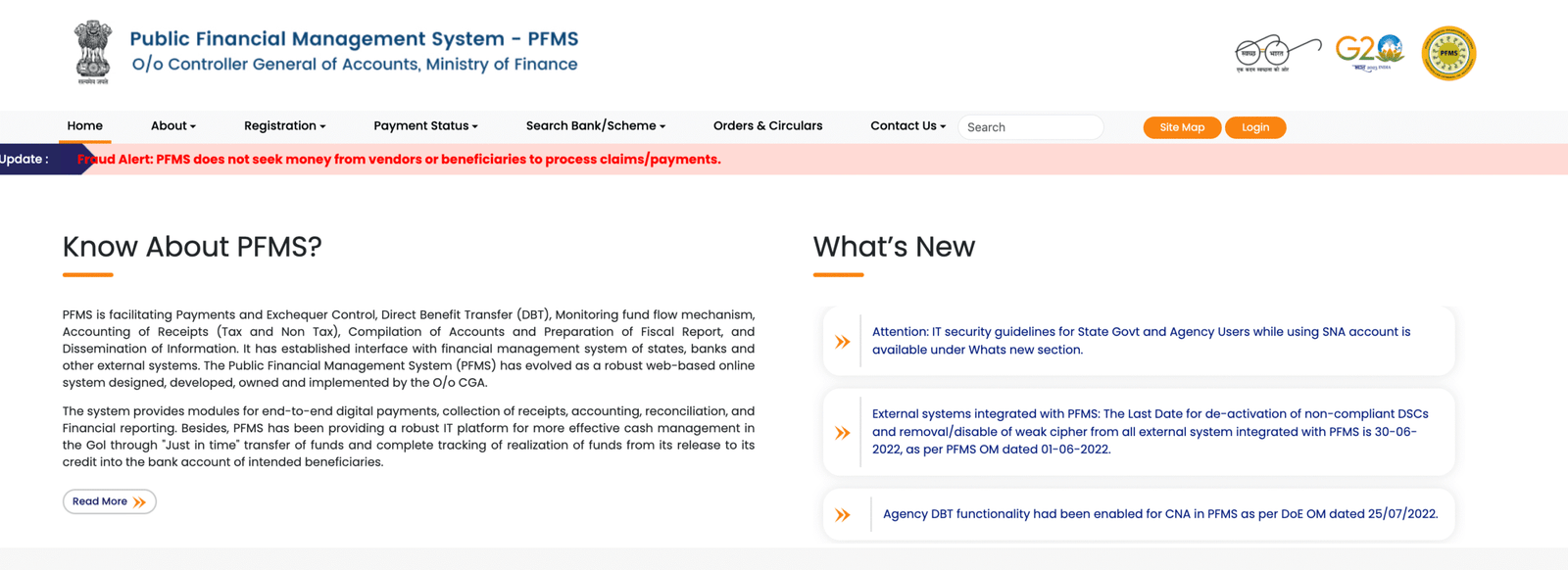
PFMS and GIFMIS: Understanding the Government Integrated Financial System
India’s public finance system is becoming more connected than ever before. Earlier, different parts of the system—budgeting, payments, accounting, and reporting—often worked separately. This created delays, duplication, and gaps in tracking.
To fix this, the government is moving toward a more unified model often referred to as GIFMIS (Government Integrated Financial Management Information System). At the center of this transformation is PFMS (Public Financial Management System).

What GIFMIS Means in Simple Terms
GIFMIS is not just one software. It’s a concept of integration.
It aims to bring together:
- Budgeting
- Fund allocation
- Payments
- Accounting
- Reporting
…into a single connected system.
PFMS portal: https://pfms.nic.in/Home.aspx
PFMS is the core platform that makes this integration possible.
How PFMS Fits into GIFMIS
PFMS already handles key financial functions:
- Processing payments
- Tracking fund flow
- Managing DBT (Direct Benefit Transfer)
- Generating financial reports
In the GIFMIS framework, PFMS acts as the central execution and tracking layer.
Key Components of GIFMIS
1. Budgeting Systems
- Preparation and allocation of budgets
- Managed by finance ministries and departments
2. PFMS (Execution Layer)
- Processes payments
- Tracks expenditure
- Records transactions
3. Treasury Systems
- Handle receipts and payments at state level
- Maintain accounts
4. Banking and RBI Systems
- Execute actual fund transfers
- Maintain government accounts
5. Reporting and Audit Systems
- Generate financial statements
- Support audits and compliance
How PFMS Connects These Components
PFMS acts as a bridge between all parts.
1. Linking Budget to Spending
- Budget allocations are mapped in PFMS
- Expenditure is tracked against these allocations
2. Connecting with Treasury Systems
- Data flows between PFMS and state treasuries
- Ensures consistency in records
3. Integrating with Banks
- Payments are processed through banks
- PFMS records and tracks transactions
4. Supporting Reporting and Audits
- Data from PFMS feeds into reports
- Used for audits and financial statements
How GIFMIS Works in Practice
1. Budget Allocation
Government allocates funds under different schemes.
2. Fund Release and Payment
PFMS processes payments and tracks fund flow.
3. Recording and Accounting
Transactions are recorded in PFMS and treasury systems.
4. Reporting and Analysis
Data is used to generate reports and insights.
5. Audit and Verification
Auditors use the data to verify financial accuracy.
Key Features of the Integrated System
1. End-to-End Visibility
From budget to final expenditure, everything is tracked.
2. Real-Time Data
Financial information is updated instantly.
3. Standardized Processes
Uniform formats and classifications across systems.
4. Reduced Duplication
No need to maintain multiple records.
5. Better Coordination
Different departments work on a common platform.
Why This Integration Matters
1. Improved Financial Control
Government can monitor funds more effectively.
2. Faster Decision-Making
Real-time data supports quick actions.
3. Increased Transparency
Every transaction is visible and traceable.
4. Better Resource Utilization
Funds are used more efficiently.
5. Stronger Accountability
Clear records make it easier to assign responsibility.
Challenges in Building GIFMIS
Despite progress, some challenges remain:
- Integration of legacy systems
- Differences in state-level systems
- Data synchronization issues
- Need for training and capacity building
These are being addressed gradually.
Recent Developments (2025–2026)
- Expansion of PFMS capabilities
- Better integration with treasury systems
- Improved dashboards and analytics
- Progress toward PFMS 2.0
PFMS features: https://pfms.nic.in/SitePages/Features.aspx
These updates are strengthening GIFMIS.
Impact on Governance
GIFMIS is changing how government finances are managed:
Earlier:
- Fragmented systems
- Delayed reporting
- Limited visibility
Now:
- Integrated systems
- Real-time tracking
- Data-driven governance
This improves overall efficiency.
Conclusion
GIFMIS represents the future of public financial management in India—a system where every part of government finance is connected. PFMS plays a central role in making this vision a reality.
By linking budgeting, payments, and reporting into one integrated framework, the government can manage funds more efficiently and transparently. As this system continues to evolve, it will become the backbone of modern financial governance in the country.
FAQs
Q1. What is GIFMIS?
A: It is an integrated system connecting budgeting, payments, accounting, and reporting.
Q2. Is PFMS the same as GIFMIS?
A: No, PFMS is a key part of GIFMIS.
Q3. Why is integration important?
A: It improves transparency, efficiency, and financial control.
Q4. Does GIFMIS include state systems?
A: Yes, it integrates with state treasury systems.
Q5. Who manages GIFMIS?
A: It involves multiple agencies, led by the government’s finance departments.
Q6. Is GIFMIS fully implemented?
A: It is evolving and expanding gradually.