PFMS Treasury Single Account (TSA): How It Works
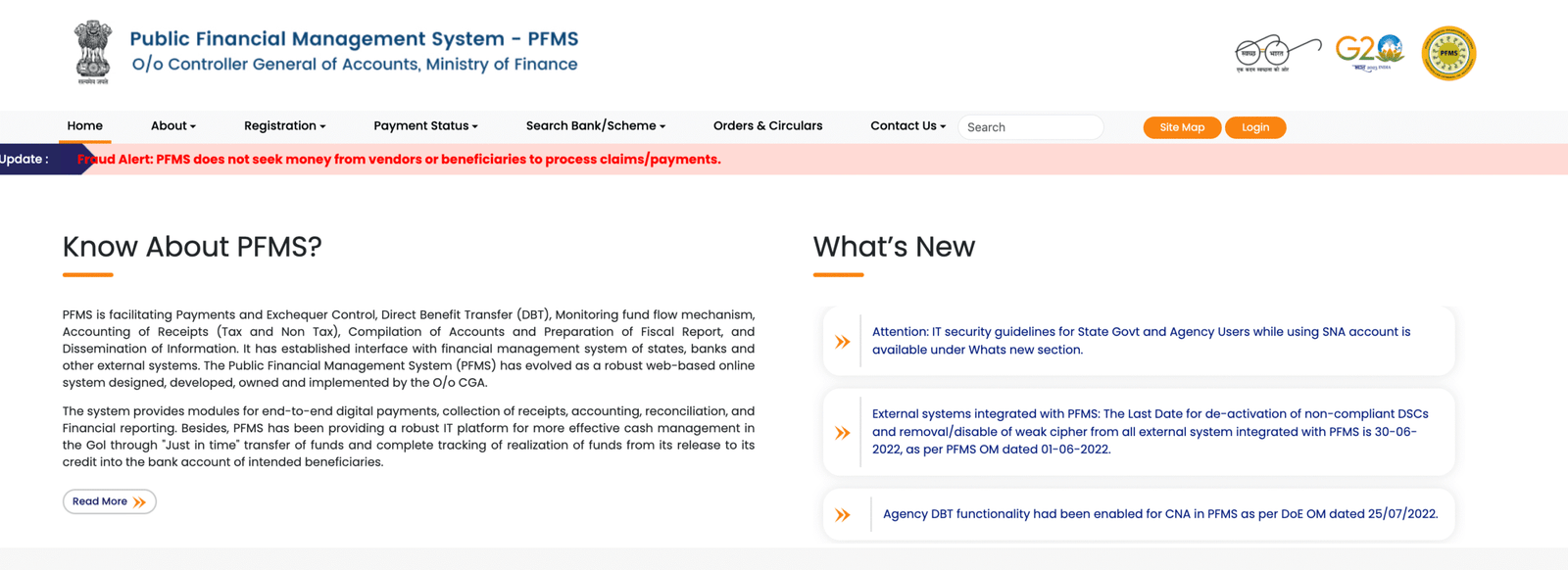
Managing government funds across hundreds of schemes and thousands of agencies can easily become chaotic. Earlier, money would sit idle in multiple bank accounts, tracking was slow, and transparency was limited. To fix this, the government introduced the Treasury Single Account (TSA) framework, integrated with PFMS.
This system brings all funds under one structured mechanism—so money is released only when needed, tracked in real time, and used efficiently.
What the TSA System Really Changes
Instead of transferring large funds in advance to different agencies, TSA works differently:
- Funds remain with the government (in a central account)
- Agencies do not hold idle balances
- Payments are made just-in-time through PFMS
👉 PFMS portal: https://pfms.nic.in/Home.aspx
This shift has improved both control and efficiency in public finance.
The Core Idea Behind TSA
At its heart, TSA is about centralized fund management.
- One unified account structure
- Controlled fund release
- Real-time tracking of spending
It ensures that money is not unnecessarily parked in multiple accounts across the system.
How TSA Works in Practice (Simplified)
1. Funds Stay in Government Account
Instead of releasing full funds to agencies:
- Money remains in a central government account
- Usually maintained with RBI or authorized banks
This prevents idle fund accumulation.
2. Agencies Raise Payment Requests
Implementing agencies (ministries, departments, etc.):
- Submit payment requests through PFMS
- Specify beneficiary and amount
- Attach necessary approvals
No upfront bulk funding is given.
3. PFMS Validates the Request
Before releasing funds:
- Beneficiary details are checked
- Budget availability is verified
- Authorization is confirmed
Only valid requests move forward.
4. Just-in-Time Fund Release
Once approved:
- PFMS releases funds only for that specific payment
- Money flows directly to beneficiary or vendor
This is called Just-in-Time (JIT) funding.
5. Direct Payment to Beneficiary
Funds are transferred:
- Through DBT (for individuals)
- Through bank transfer (for vendors/agencies)
No intermediate holding of funds.
6. Real-Time Recording and Monitoring
PFMS records:
- Payment details
- Date and amount
- Scheme and purpose
Authorities can monitor everything instantly.
Key Features of PFMS TSA System
1. Just-in-Time Funding
Money is released only when required, not in advance.
2. Centralized Control
Government retains control over funds until final payment.
3. Zero Idle Balances
Agencies don’t keep unused funds in accounts.
4. Real-Time Tracking
All transactions are visible immediately in PFMS.
5. Improved Cash Management
Government can plan cash flow more efficiently.
Why TSA Matters in Government Schemes
1. Prevents Fund Parking
Earlier, funds would sit unused in multiple accounts. TSA eliminates this.
2. Reduces Leakages
Direct payments reduce chances of misuse or diversion.
3. Improves Efficiency
Payments are faster and more targeted.
4. Strengthens Financial Discipline
Agencies must justify each payment request.
5. Better Budget Utilization
Funds are used only when required, reducing wastage.
Where TSA Is Used
TSA is widely used in:
- Centrally Sponsored Schemes
- Central Sector Schemes
- Grants to states and agencies
- Large-scale DBT programs
It is especially useful where multiple agencies are involved.
Difference Between Old System and TSA
Earlier System:
- Bulk funds released in advance
- Money parked in multiple accounts
- Limited tracking
TSA System:
- Funds released on demand
- Centralized control
- Full digital tracking through PFMS
This shift has significantly improved transparency.
Challenges in TSA Implementation
Like any system, TSA also faces some issues:
- Need for strong digital infrastructure
- Training required for agencies
- Delays if approvals are slow
- Dependence on PFMS system availability
However, these are being addressed gradually.
Recent Updates (2025–2026)
- Expansion of TSA to more schemes
- Improved PFMS dashboards for monitoring
- Faster approval workflows
- Better integration with banking systems
👉 PFMS features: https://pfms.nic.in/SitePages/Features.aspx
These improvements are making TSA more efficient.
How TSA Improves Governance
TSA is not just a financial tool—it changes governance itself:
- Decision-making becomes data-driven
- Funds are used more responsibly
- Transparency increases across departments
It ensures that public money is handled with greater care.
FAQs
1. What is a Treasury Single Account (TSA)?
It is a system where government funds are kept in a centralized account and released only when needed.
2. How does PFMS support TSA?
PFMS processes payment requests, validates data, and releases funds in real time.
3. What is Just-in-Time funding?
It means funds are released only at the time of actual payment, not in advance.
4. Do agencies hold funds in TSA?
No, funds remain with the government until payment is made.
5. Why is TSA important?
It improves transparency, reduces idle funds, and ensures efficient use of money.
6. Is TSA used in all schemes?
It is increasingly being adopted across many central and sponsored schemes.
Conclusion
The Treasury Single Account system, powered by PFMS, has transformed how government funds are managed in India. By shifting from bulk fund releases to just-in-time payments, it brings better control, transparency, and efficiency.
In a system handling massive public funds, even small improvements can make a big difference. TSA ensures that money is not just spent—but spent wisely, at the right time, and for the right purpose.