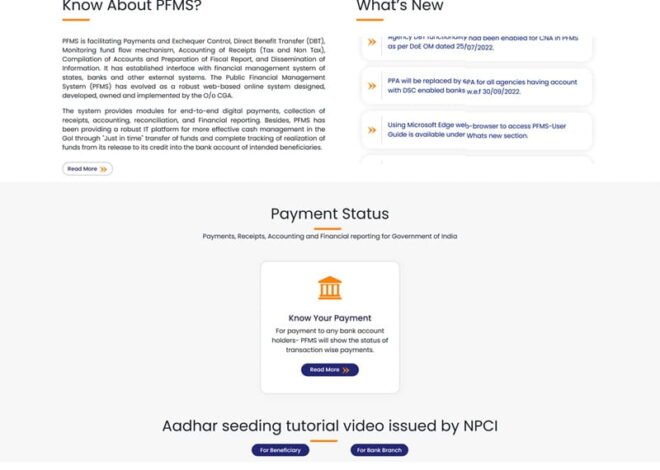
How PFMS Helps the CAG in Government Auditing
Auditing government finances in a country like India is not a small task. Thousands of schemes, millions of transactions, and funds moving across ministries, states, and agencies every day—it’s a massive system to verify.
This responsibility lies with the Comptroller and Auditor General (CAG). And in recent years, PFMS (Public Financial Management System) has become one of the most important tools supporting this work.
Instead of chasing paper records and delayed reports, auditors now rely heavily on PFMS data to understand how public money is used.
Why Auditing Needs a System Like PFMS
Government auditing focuses on three key questions:
- Was the money used for the intended purpose?
- Was it spent correctly and legally?
- Is there any misuse or irregularity?
👉 PFMS portal: https://pfms.nic.in/Home.aspx
To answer these, auditors need accurate, timely, and complete data—and PFMS provides exactly that.
PFMS as a Central Financial Record
PFMS acts as a single source of financial data.
- Records transactions from ministries and departments
- Tracks fund releases and expenditure
- Stores payment and beneficiary details
For auditors, this means:
- One platform to access data
- Less dependence on scattered records
How PFMS Supports the CAG in Auditing
1. Complete Transaction Trail
PFMS maintains:
- Payment history
- Fund release records
- Beneficiary details
Auditors can trace every rupee from allocation to final use.
2. Real-Time Data Availability
Instead of waiting for year-end reports:
- Auditors can access current data
- Identify issues early
- Conduct ongoing audits
This improves efficiency.
3. Standardized Financial Data
PFMS uses uniform formats:
- Same classification across departments
- Consistent reporting structure
This makes comparison and analysis easier.
4. Support for Utilization Verification
Auditors check whether funds are used properly.
PFMS helps by:
- Showing actual expenditure data
- Matching it with reported utilization certificates (UCs)
5. Detection of Irregularities
PFMS data helps identify:
- Duplicate payments
- Unusual spending patterns
- Delays in fund utilization
These are key audit red flags.
6. Integration with Other Systems
PFMS connects with:
- Banking systems
- Treasury systems
- Scheme portals
This ensures auditors get a complete picture.
Types of Audits Supported by PFMS
1. Financial Audit
- Verifies accuracy of financial records
2. Compliance Audit
- Checks whether rules and guidelines are followed
3. Performance Audit
- Evaluates whether funds achieved intended outcomes
PFMS data supports all three.
Role in Expenditure Verification
PFMS allows auditors to:
- Check scheme-wise spending
- Verify payments to beneficiaries
- Compare allocation vs utilization
This ensures funds are not misused.
Role in Revenue and Receipts Tracking
Through integration with systems like Bharatkosh:
- Non-tax revenue is recorded
- Receipts can be verified
This completes the financial picture.
Benefits for the CAG
1. Faster Audits
Less time spent collecting data.
2. Higher Accuracy
Digital records reduce errors.
3. Better Transparency
Clear visibility of transactions.
4. Stronger Evidence
PFMS provides reliable audit data.
5. Data-Driven Auditing
Auditors can use analytics to detect patterns.
Challenges in Using PFMS for Audits
Some limitations still exist:
- Data depends on timely entry by departments
- Integration gaps in some areas
- Need for training in data analysis
However, these are improving over time.
Recent Developments (2025–2026)
- Improved analytics tools in PFMS
- Better dashboards for audit review
- Faster reconciliation processes
- Enhanced data validation systems
👉 PFMS reports: https://pfms.nic.in/SitePages/Reports.aspx
These updates strengthen audit capabilities.
How PFMS Changes Traditional Auditing
Earlier:
- Paper-based records
- Delayed data
- Limited visibility
Now:
- Digital transaction tracking
- Real-time access
- Comprehensive data coverage
This shift has modernized government auditing.
Best Practices for Audit Use
Auditors and departments should:
- Ensure timely data entry
- Cross-check PFMS data with ground records
- Use analytics tools for deeper insights
- Monitor high-risk transactions
This improves audit quality.
FAQs
1. What is the role of CAG?
CAG audits government accounts and ensures proper use of public funds.
2. How does PFMS help in auditing?
It provides real-time, accurate financial data for verification.
3. Can PFMS detect fraud?
It helps identify suspicious patterns, but detailed investigation is required.
4. Is PFMS data used in all audits?
It is widely used, especially for scheme-related audits.
5. Does PFMS replace traditional audit methods?
No, it supports and enhances them.
6. What are utilization certificates (UCs)?
They confirm that funds have been used properly.
Conclusion
PFMS has become a powerful support system for the CAG in auditing government finances. By providing a clear, real-time view of financial transactions, it makes audits faster, more accurate, and more effective.
In a system handling massive public funds, transparency is critical. PFMS ensures that auditors have the data they need to verify every transaction—and that public money is used responsibly.