How PFMS Saved the Indian Exchequer Billions
There was a time when government money in India moved through a long, messy chain. Funds passed from the Centre to states, then to districts, then to agencies, and only finally to the beneficiary. At every step, delays crept in. Records got distorted. Leakages were common. In many cases, money either arrived late—or never reached the intended person at all.
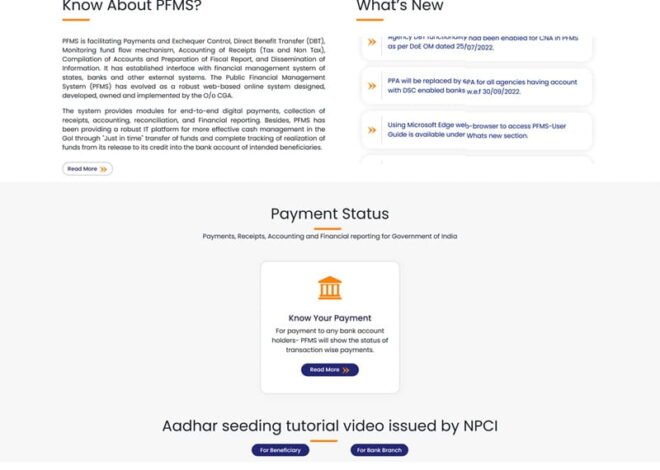
That’s the problem the Public Financial Management System (PFMS) set out to fix.
Today, PFMS has quietly become one of the most powerful financial control systems in India. It doesn’t just track money. It controls how money moves, where it goes, and whether it reaches the right person. And in doing so, it has saved the Indian exchequer billions of rupees.
The Problem Before PFMS
Before PFMS was introduced in 2009, fund management was largely manual and fragmented.
Here’s what the system looked like:
- Multiple layers between sender and receiver
- Limited real-time tracking
- Delayed reporting of expenditure
- High chances of duplication and fake beneficiaries
- Idle funds lying unused in different accounts
In simple terms, the government often didn’t have a clear picture of where its money was at any given time.
This lack of visibility led to massive inefficiencies—and financial losses.
What PFMS Changed
PFMS brought a complete shift in how public money is handled.
Instead of a scattered system, it created a centralized digital platform that connects:
- Government departments
- Banks
- Agencies
- Beneficiaries
Now, every transaction is recorded, tracked, and verified in real time.
The system introduced three major changes:
1. Direct Payments Instead of Layered Transfers
Funds now move directly from the government to the beneficiary’s bank account.
2. Real-Time Monitoring
Authorities can track fund flow at every stage.
3. Data-Based Decision Making
Financial data is available instantly for analysis and planning.
Direct Benefit Transfer: The Biggest Game Changer
One of PFMS’s strongest contributions is enabling Direct Benefit Transfer (DBT).
Under DBT:
- Subsidies and benefits are sent directly to bank accounts
- Aadhaar-based verification ensures authenticity
- Middlemen are eliminated
Earlier, subsidies passed through multiple hands. Each step increased the risk of leakage. Now, money goes straight to the beneficiary.
This single shift has saved enormous amounts of public money.
Elimination of Ghost Beneficiaries
Before PFMS and DBT integration, many schemes suffered from “ghost beneficiaries”—fake or duplicate entries created to siphon off funds.
PFMS changed that by:
- Linking payments with Aadhaar and bank accounts
- Verifying identity through NPCI systems
- Removing duplicate records
As a result, lakhs of fake beneficiaries were eliminated across various schemes.
That alone translated into massive savings for the government.
Just-in-Time Fund Release
Earlier, large sums of money were released in advance to departments and agencies. Much of it remained unused for long periods.
PFMS introduced the concept of Just-in-Time (JIT) funding:
- Funds are released only when needed
- Idle balances are minimized
- Cash management becomes more efficient
This ensures that government money is not sitting unused in accounts but is deployed exactly when required.
Better Financial Discipline
PFMS enforces strict financial discipline across departments.
Every rupee is:
- Accounted for
- Tagged to a scheme
- Linked to a transaction
- Recorded in real time
This level of transparency reduces misuse and forces better planning.
Departments now have to justify spending with actual data—not estimates.
Integration with Banks and Systems
PFMS is integrated with hundreds of banks and financial systems across India.
This allows:
- Seamless digital payments (NEFT, RTGS, Aadhaar-based)
- Instant validation of account details
- Faster processing of transactions
Because of this integration, errors are caught early, and incorrect payments are prevented before they happen.
Real-Time Reporting and Transparency
Another major advantage is real-time reporting.
Government officials can now:
- Track fund flow scheme-wise
- Monitor state-wise expenditure
- Identify delays or bottlenecks
- Analyze performance instantly
This transparency has made it much harder for funds to be misused or hidden.
Reduction in Administrative Costs
PFMS has also reduced operational costs significantly.
Earlier, managing funds involved:
- Paperwork
- Manual approvals
- Physical tracking
Now, everything is digital.
This reduces:
- Administrative burden
- Processing time
- Human errors
Faster systems mean lower costs—and better efficiency.
Impact Across Major Government Schemes
PFMS is used across major schemes like:
- MGNREGA
- PM-KISAN
- Scholarship programs
- LPG subsidy
In all these schemes, PFMS ensures:
- Timely payments
- Accurate beneficiary targeting
- Reduced leakage
The cumulative savings across these large-scale programs run into billions.
Challenges and Limitations
Despite its success, PFMS is not without challenges:
- System complexity for new users
- Occasional technical glitches
- Dependence on accurate data entry
- Banking delays in some cases
However, these issues are minor compared to the benefits it delivers.
The Bigger Picture
PFMS is not just a financial tool. It represents a shift in governance.
It moves the system from:
- Assumption → to verification
- Delay → to real-time tracking
- Leakage → to accountability
It ensures that public money is used for public benefit—without loss along the way.
Final Thoughts
PFMS may not be visible to the average citizen, but its impact is everywhere. From faster subsidies to cleaner government accounts, the system has transformed how India manages its finances.
By reducing leakages, eliminating fake beneficiaries, and ensuring precise fund flow, PFMS has saved the Indian exchequer billions—and continues to do so every day.
It’s one of those silent reforms that doesn’t make headlines often, but quietly changes everything underneath.