PFMS and Pradhan Mantri Awas Yojana: Housing Fund Tracking
Pradhan Mantri Awas Yojana (PMAY) is one of India’s biggest housing programs. Its goal is simple—provide affordable housing to eligible families. But behind every house built, there’s a detailed financial system making sure the money reaches the right place at the right time.
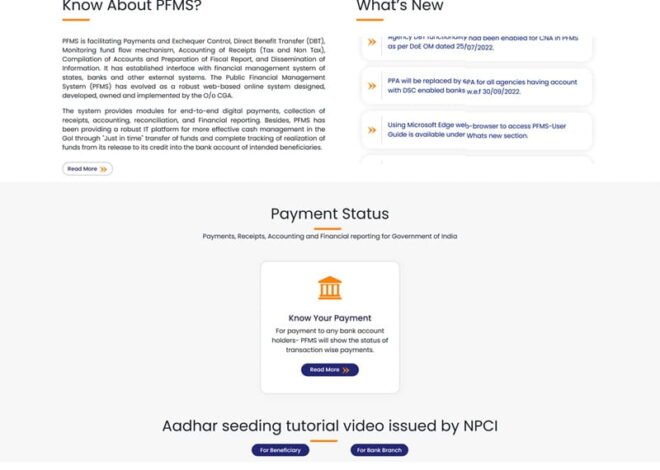
That system is PFMS (Public Financial Management System). It quietly tracks every rupee released under PMAY, from approval to final construction.
How Housing Funds Flow Under PMAY
Unlike schemes where money is given in one go, PMAY works in stages.
- Funds are released in installments
- Payments are linked to construction progress
- Beneficiaries or agencies receive money step by step
👉 PMAY official portal: https://pmaymis.gov.in/
👉 PFMS portal: https://pfms.nic.in/Home.aspx
PFMS records each of these stages and keeps everything transparent.
Step-by-Step: How PFMS Tracks Housing Funds
1. Beneficiary Selection and Approval
The process begins with identifying eligible families.
- Based on income category (EWS, LIG, etc.)
- Verified through surveys and local authorities
- Approved list uploaded into the system
Each approved beneficiary gets a unique ID for tracking.
2. Sanction of House and Fund Allocation
Once approved:
- Government sanctions the house
- Total financial assistance is fixed
- Funds are allocated in PFMS
This creates a digital record of the commitment.
3. Installment-Based Payment Structure
PMAY funds are not released at once.
Typical structure:
- First installment → for starting construction
- Second installment → after foundation/lintel stage
- Final installment → after completion
PFMS records each installment separately.
4. Verification of Construction Progress
Before releasing the next installment:
- Officials verify construction progress
- Geo-tagged photos are uploaded
- Physical inspection may be done
Only after verification does PFMS allow the next payment.
5. Payment Processing Through PFMS
Once verified:
- Payment request is generated
- Beneficiary bank details are checked
- Funds are released digitally
👉 Learn about PFMS DBT system: https://pfms.nic.in/SitePages/about-Verticals-DBT.aspx
PFMS ensures that payments are accurate and authorized.
6. Direct Credit to Beneficiary Account
Funds are transferred directly:
- Into the beneficiary’s bank account
- Often linked with Aadhaar
- Without intermediaries
This reduces chances of corruption or delay.
7. Real-Time Monitoring and Reporting
PFMS keeps full transaction records:
- Amount released in each installment
- Dates of payment
- Beneficiary details
- Scheme progress
Authorities can monitor housing projects across the country in real time.
Key Features of PFMS in PMAY
1. Stage-Wise Fund Tracking
Each installment is linked to construction progress.
2. Transparency
All payments are recorded digitally and can be audited.
3. Direct Benefit Transfer
Money goes straight to beneficiaries’ bank accounts.
4. Integration with Geo-Tagging
Construction progress is verified with location-based images.
5. Centralized Monitoring
Government can track progress across states and districts.
6. Error Reduction
Duplicate or incorrect payments are minimized.
Why PFMS Matters in Housing Schemes
1. Prevents Misuse of Funds
Earlier, funds could be diverted. Now, every rupee is tracked.
2. Ensures Timely Construction
Installments push beneficiaries to complete houses on time.
3. Improves Accountability
Officials and agencies are accountable for delays or errors.
4. Builds Trust Among Beneficiaries
People feel confident when payments are direct and transparent.
5. Supports Large-Scale Implementation
Managing millions of houses becomes possible with digital tracking.
Common Issues in Fund Tracking
Some challenges still exist:
- Delay in verification of construction stages
- Incorrect bank details
- Aadhaar linking issues
- Slow updates in rural areas due to connectivity
These can delay installment release, even if construction is ongoing.
Recent Updates (2025–2026)
- Increased use of geo-tagging for better verification
- Faster approval systems for installment release
- Improved PFMS dashboards for tracking fund flow
- Greater focus on rural housing under PMAY-G
👉 PMAY guidelines: https://pmaymis.gov.in/PDF/PMAY_U_Guidelines.pdf
These updates aim to speed up construction and reduce delays.
FAQs
1. How are PMAY funds released?
Funds are released in installments based on construction progress.
2. Who receives the money?
Money is directly credited to the beneficiary’s bank account.
3. How does PFMS help in PMAY?
PFMS tracks fund allocation, processes payments, and records every transaction.
4. Why are installments delayed sometimes?
Delays can happen due to verification issues, incorrect bank details, or pending approvals.
5. Can beneficiaries track payments?
Yes, payments can be checked through PFMS or scheme portals.
6. Is Aadhaar mandatory for PMAY payments?
In most cases, Aadhaar linking helps ensure accurate and faster payments.
Conclusion
PMAY is not just about building houses—it’s about delivering financial support in a structured and reliable way. PFMS makes this possible by tracking every stage of fund flow.
From sanction to final installment, everything is recorded, verified, and monitored. This ensures that housing funds are used properly and reach the right people.
In the end, PFMS turns a massive housing mission into a controlled, transparent, and efficient system that works on the ground.