PFMS Role in Annual Union Government Accounts: Explained
Every year, the Government of India prepares its Annual Union Government Accounts. This document is more than a financial summary—it’s the official record of how public money was received, spent, and managed during the year. It is used by Parliament, auditors, policymakers, and even researchers.
But preparing such a massive account for a country like India is not easy. Thousands of transactions happen daily across ministries, departments, and agencies. This is where PFMS (Public Financial Management System) plays a crucial role.
Why Annual Accounts Matter
The Annual Accounts include:
- Receipts (tax and non-tax revenue)
- Expenditure (schemes, salaries, grants, etc.)
- Fiscal deficit and borrowing details
These accounts are:
- Submitted to Parliament
- Audited by the Comptroller and Auditor General (CAG)
- Used for policy and budget planning
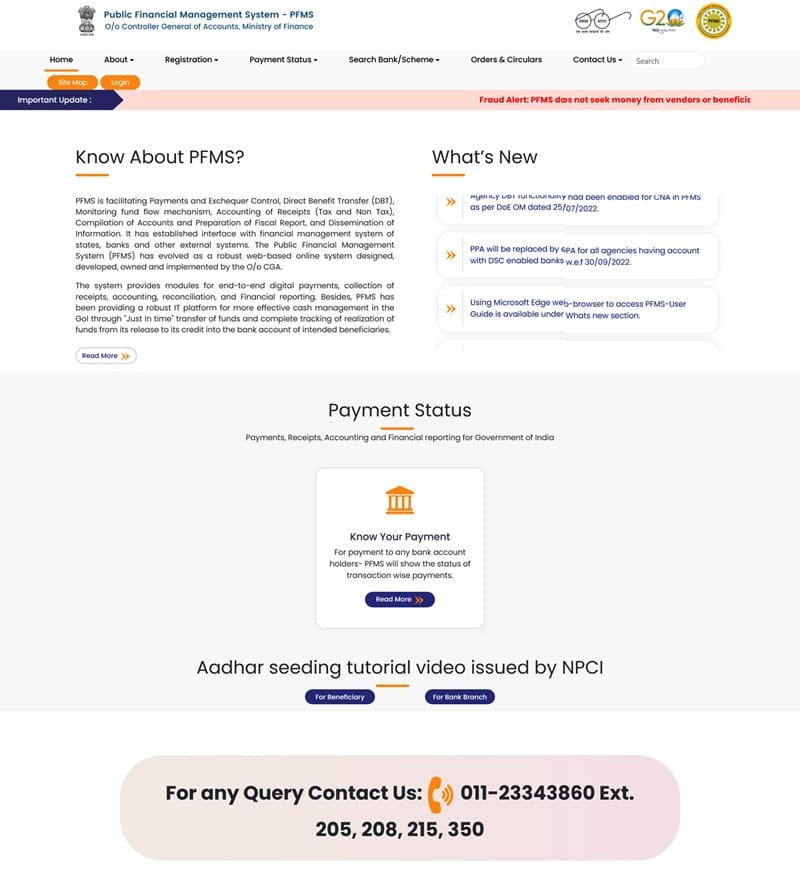
PFMS portal: https://pfms.nic.in/Home.aspx
Accuracy and completeness are critical, and PFMS helps ensure both.
PFMS as the Foundation of Financial Data
PFMS acts as a central financial data repository.
- Records transactions from multiple ministries
- Captures scheme-wise and department-wise spending
- Stores real-time data throughout the year
Instead of collecting data at the end of the year, PFMS builds the dataset continuously.
How PFMS Supports Preparation of Annual Accounts
1. Continuous Data Collection
Throughout the financial year:
- Payments and receipts are recorded in PFMS
- Data is updated daily
- No need for last-minute compilation
This reduces errors and delays.
2. Standardized Financial Classification
PFMS uses uniform coding for:
- Heads of accounts
- Schemes and programs
- Types of expenditure
This ensures consistency across ministries.
3. Real-Time Expenditure Tracking
Ministries track:
- Budget allocation
- Actual spending
- Remaining balance
This data feeds directly into annual accounts.
4. Integration with Other Systems
PFMS connects with:
- Banking systems
- Treasury systems
- Departmental systems
This ensures comprehensive data coverage.
5. Support for Reconciliation
Before finalizing accounts:
- PFMS data is matched with bank and treasury records
- Differences are identified and corrected
This improves accuracy.
6. Generation of Financial Reports
PFMS helps generate:
- Monthly and quarterly reports
- Year-end summaries
- Scheme-wise expenditure reports
These form the building blocks of annual accounts.
Role in Expenditure Accounting
PFMS plays a major role in tracking expenditure:
- Captures payments made under various schemes
- Records grants to states and agencies
- Tracks administrative expenses
This ensures that all spending is accounted for properly.
Role in Receipts and Non-Tax Revenue
Through systems like Bharatkosh:
- Non-tax revenue is recorded
- Fees, charges, and deposits are tracked
- Data is integrated into PFMS
This contributes to the revenue side of accounts.
Contribution to Fiscal Transparency
PFMS improves transparency by:
- Providing real-time financial data
- Making information accessible to authorities
- Ensuring traceability of every transaction
This strengthens public accountability.
How PFMS Helps the Controller General of Accounts (CGA)
The CGA is responsible for preparing Union Government accounts.
PFMS helps CGA by:
- Providing centralized data
- Reducing manual compilation
- Improving accuracy of reports
- Speeding up account finalization
This makes the entire process more efficient.
Key Features That Support Annual Accounts
1. Centralized Database
All financial data is stored in one place.
2. Automation
Reduces manual errors and workload.
3. Real-Time Updates
Ensures up-to-date information.
4. Data Validation
Checks for inconsistencies and errors.
5. Audit Support
Provides ready access to transaction records.
Challenges in Using PFMS for Annual Accounts
Some challenges still exist:
- Data delays from lower levels
- Integration gaps with older systems
- Need for continuous data validation
- Training requirements for users
These are being addressed gradually.
Recent Developments (2025–2026)
- Improved data analytics tools in PFMS
- Faster reconciliation processes
- Enhanced reporting dashboards
- Better integration with treasury and banking systems
PFMS reports: https://pfms.nic.in/SitePages/Reports.aspx
These upgrades are strengthening financial reporting.
Impact on Government Accounting
PFMS has transformed the process:
Earlier:
- Manual data collection
- Delayed reporting
- Higher chances of errors
Now:
- Real-time data capture
- Automated reporting
- Greater accuracy and transparency
This shift has modernized public financial management.
FAQs
1. What are Annual Union Government Accounts?
They are official records of government receipts, expenditure, and financial position for a year.
2. How does PFMS help in preparing these accounts?
PFMS collects, validates, and organizes financial data throughout the year.
3. Who prepares the annual accounts?
The Controller General of Accounts (CGA) prepares them.
4. Does PFMS track all government transactions?
It tracks a large portion, especially scheme-related and central payments.
5. Why is reconciliation important?
It ensures that PFMS data matches actual bank and treasury records.
6. Is PFMS data used in audits?
Yes, it is a key source for auditing government accounts.
Conclusion
PFMS plays a foundational role in the preparation of Annual Union Government Accounts. By capturing financial data in real time and organizing it systematically, it removes the need for complex, error-prone manual processes.
In a country with such a vast financial system, this level of accuracy and transparency is essential. PFMS ensures that the government’s financial story—how money was earned and spent—is clear, reliable, and ready for scrutiny.