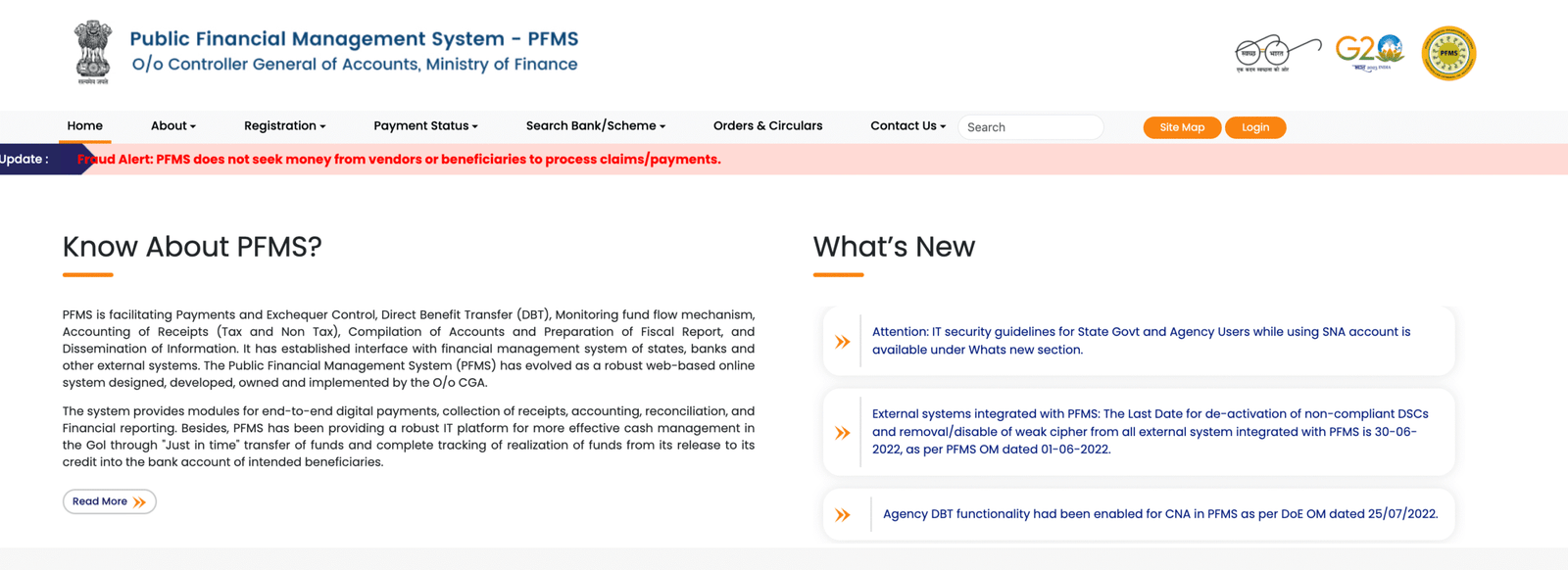
How PFMS Validates Bank Account Numbers Before Payment
When the government sends money through PFMS (Public Financial Management System), accuracy is everything. A single wrong digit in a bank account number can send funds to the wrong person or cause payment failure. That’s why PFMS follows a strict validation process before releasing any payment.
This validation system works quietly in the background, but it’s one of the most important parts of Direct Benefit Transfer (DBT).
Why Bank Account Validation Is Critical
Government payments involve crores of transactions every month:
- Subsidies
- Scholarships
- Pensions
- Wages
If bank details are incorrect:
- Payments may fail
- Funds may get delayed
- Beneficiaries may face hardship
To avoid this, PFMS verifies account details at multiple levels before processing payments.
What Details PFMS Checks Before Payment
PFMS doesn’t rely on just one field. It validates a combination of details:
- Bank account number
- IFSC code
- Bank name and branch
- Aadhaar linkage (if applicable)
All these must match correctly for successful payment.
Step-by-Step: How PFMS Validates Bank Account Numbers
1. Data Entry and Initial Screening
When beneficiary details are entered:
- Account number is checked for format errors
- IFSC code is verified against RBI database
- Mandatory fields are validated
This removes basic mistakes early.
2. Bank Account Verification with CBS
PFMS connects with the bank’s Core Banking System (CBS):
- Sends account details to the bank
- Bank confirms whether account exists
- Validates account status (active/inactive)
If the account is invalid, it is flagged immediately.
3. Name Matching and Consistency Check
PFMS may compare:
- Beneficiary name
- Bank account holder name
Even small mismatches can cause issues in some cases.
4. Aadhaar-Based Validation (If Used)
If Aadhaar is linked:
- PFMS checks Aadhaar-bank mapping via NPCI
- Ensures Aadhaar is linked to correct account
- Verifies DBT eligibility
This adds another layer of accuracy.
5. NPCI Mapping Check
For Aadhaar-based payments:
- NPCI database identifies the destination bank
- Confirms correct routing of funds
If mapping is missing or incorrect, payment may fail.
6. Duplicate and Error Detection
PFMS scans for:
- Duplicate account entries
- Suspicious patterns
- Repeated or conflicting data
This helps prevent fraud and duplication.
7. Pre-Payment Validation Status
Before final payment:
- PFMS marks records as “validated” or “rejected”
- Only validated records move forward
- Errors must be corrected before retry
This ensures only clean data enters the payment system.
Types of Validation Used in PFMS
1. Format Validation
Checks structure of account number and IFSC code.
2. Bank-Level Validation
Confirms account existence through bank systems.
3. Aadhaar-Based Validation
Ensures correct linking for DBT payments.
4. Logical Validation
Detects duplicates or inconsistent entries.
5. Status Validation
Checks whether account is active and operational.
What Happens If Validation Fails?
If PFMS detects an issue:
- Payment is stopped
- Error message is generated
- Record is marked as failed or rejected
Common failure reasons include:
- Wrong account number
- Incorrect IFSC code
- Closed bank account
- Aadhaar not linked properly
The data must be corrected before reprocessing.
Key Features of PFMS Validation System
1. Multi-Layer Checking
Validation happens at multiple stages, not just once.
2. Real-Time Feedback
Errors are identified quickly.
3. Integration with Banks and NPCI
Direct connection ensures accurate verification.
4. Fraud Prevention
Duplicate or fake accounts are filtered out.
5. High Accuracy Rate
Reduces payment failures significantly.
Benefits of Strong Validation
1. Ensures Correct Payment Delivery
Money reaches the right beneficiary.
2. Reduces Payment Failures
Fewer rejected transactions.
3. Saves Time and Effort
Less need for manual correction later.
4. Builds Trust in DBT System
Beneficiaries feel confident about receiving funds.
5. Improves System Efficiency
Smooth processing of large-scale payments.
Common Issues Faced by Beneficiaries
Even with validation, users may face problems:
- Typing errors in account number
- Outdated bank details
- Inactive or dormant accounts
- Missing Aadhaar linkage
- KYC not completed
These issues can be resolved by updating bank details.
Recent Improvements (2025–2026)
- Faster bank validation APIs
- Improved NPCI mapping accuracy
- Better error reporting in PFMS portal
- Enhanced duplicate detection systems
👉 PFMS help section: https://pfms.nic.in/SitePages/FAQs.aspx
These upgrades are making validation more reliable.
Tips to Avoid Payment Failures
Beneficiaries should:
- Double-check account number and IFSC
- Keep bank account active
- Complete KYC requirements
- Link Aadhaar (if required)
- Update details in scheme portal
Small precautions can prevent delays.
FAQs
1. How does PFMS verify bank accounts?
PFMS checks account details with bank systems and validates Aadhaar linkage if required.
2. What happens if my bank account is incorrect?
The payment will fail, and you’ll need to update correct details.
3. Is Aadhaar mandatory for validation?
Not always, but it helps in DBT payments.
4. Can PFMS detect duplicate accounts?
Yes, it has systems to identify duplicate or suspicious entries.
5. How long does validation take?
Usually quick, as it is done digitally in real time or near real time.
6. Why do payments fail even after validation?
Failures can happen due to bank issues, inactive accounts, or incorrect mapping.
Conclusion
PFMS validation is the silent safeguard behind every successful government payment. By checking bank account details at multiple levels, it ensures that funds are delivered accurately and securely.
In a system handling millions of transactions, even small errors can create big problems. That’s why PFMS focuses heavily on validation before payment.
It’s this careful checking process that makes DBT reliable, efficient, and trustworthy for millions of people across India.