PFMS and Jan Dhan Yojana: The DBT–Banking Connection
The success of Direct Benefit Transfer (DBT) in India rests on one simple idea—money should go straight to people, without delays or middlemen. But to make that happen at a national scale, two systems work closely together: Jan Dhan Yojana and PFMS (Public Financial Management System).
One provides bank accounts. The other moves and tracks money. Together, they form the backbone of India’s digital welfare system.
What is the link between PFMS and Jan Dhan Yojana?
The Pradhan Mantri Jan Dhan Yojana (PMJDY) focuses on financial inclusion by providing zero-balance bank accounts to millions of citizens.
PFMS uses these bank accounts to transfer government benefits under DBT.
- Jan Dhan → provides bank accounts
- PFMS → processes and tracks payments
- DBT → connects both systems
👉 Jan Dhan Yojana details: https://pmjdy.gov.in/
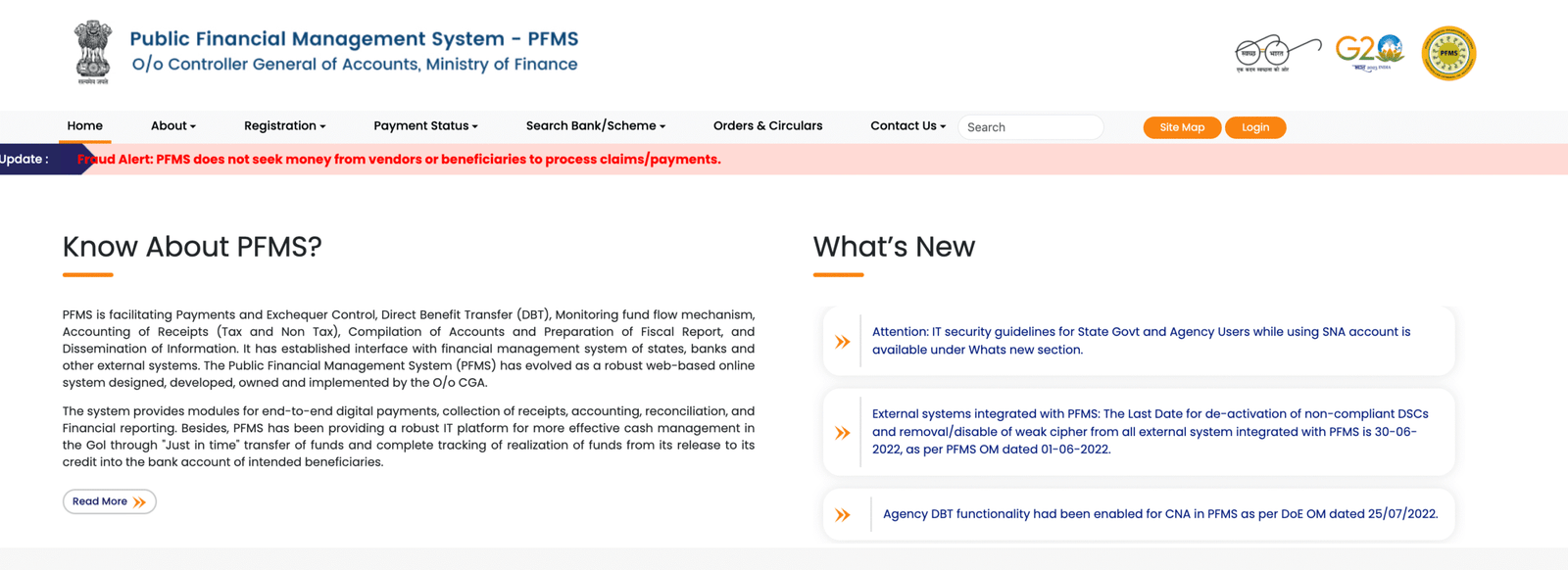
👉 PFMS portal: https://pfms.nic.in/Home.aspx
This connection ensures that government benefits reach even the most remote households.
How DBT Works with Jan Dhan Accounts
DBT (Direct Benefit Transfer) is the method used to send money directly to beneficiaries.
Here’s how it works in simple terms:
- Government approves a benefit (subsidy, pension, etc.)
- PFMS processes the payment
- Money is sent directly to the beneficiary’s Jan Dhan account
No paperwork. No agents. Just direct transfer.
Step-by-Step: How PFMS Tracks DBT Payments
1. Beneficiary Identification
Eligible individuals are identified under various schemes.
- Data collected from government databases
- Aadhaar and bank details recorded
- Jan Dhan account often used as primary account
This forms the base of the DBT system.
2. Aadhaar and Bank Account Linking
For smooth DBT flow, accounts are linked:
- Aadhaar linked to Jan Dhan account
- Bank account seeded in PFMS
- NPCI mapping done
This ensures correct identification of the beneficiary.
3. Scheme Approval and Fund Allocation
Government approves funds under a scheme.
- Budget is allocated
- Scheme data uploaded in PFMS
- Beneficiary list finalized
PFMS records every allocation digitally.
4. Payment File Creation in PFMS
PFMS prepares payment instructions:
- Validates beneficiary details
- Checks for duplicates or errors
- Generates payment file
👉 Learn more about DBT process: https://pfms.nic.in/SitePages/about-Verticals-DBT.aspx
This step is crucial to avoid payment failures.
5. Fund Transfer via Banking Network
PFMS sends payment through banking channels:
- NPCI processes Aadhaar-based payments
- NEFT/RTGS used for account-based transfers
- Money reaches Jan Dhan account
Everything happens electronically.
6. Direct Credit to Beneficiary
Once processed:
- Money is credited directly
- Beneficiary receives SMS alert
- No middlemen involved
This improves speed and trust.
7. Real-Time Tracking and Reporting
PFMS keeps full records:
- Payment date and amount
- Scheme name
- Bank status
Users and officials can track payments anytime.
Key Features of PFMS in DBT-Banking Connection
1. Seamless Integration with Banks
PFMS is connected with hundreds of banks and NPCI systems.
2. Real-Time Monitoring
Payments can be tracked instantly.
3. Error Detection
Incorrect or duplicate entries are flagged early.
4. Transparency
Every transaction is recorded and auditable.
5. Financial Inclusion Support
Jan Dhan accounts ensure even rural users receive benefits.
6. SMS and Alerts
Beneficiaries get updates on payments.
Importance of PFMS + Jan Dhan Combination
1. Last-Mile Delivery
Even people in remote villages receive money directly.
2. Reduced Corruption
No intermediaries means fewer chances of leakage.
3. Faster Payments
Funds are transferred within days, sometimes instantly.
4. Empowerment of Citizens
People gain direct control over their money.
5. Strong Digital Economy
Encourages banking habits and digital transactions.
Common Issues in DBT Payments
Despite improvements, some users face problems:
- Aadhaar not linked properly
- Bank account inactive or closed
- Incorrect account details
- NPCI mapping issues
- Delay in bank processing
Most of these can be fixed by updating KYC details.
Recent Updates
- Increased use of Aadhaar-based payment systems
- Stronger verification to prevent duplicate beneficiaries
- Expansion of DBT to more schemes
- Better PFMS dashboards for tracking payments
👉 More on Jan Dhan scheme: https://pmjdy.gov.in/scheme
These updates aim to make DBT faster and more reliable.
FAQs
1. What is the role of Jan Dhan in DBT?
Jan Dhan provides bank accounts where DBT payments are received.
2. How does PFMS help in DBT?
PFMS processes, tracks, and records all DBT payments.
3. Can DBT be received without a Jan Dhan account?
Yes, but Jan Dhan accounts are preferred for financial inclusion.
4. Why is Aadhaar linking important?
It helps verify identity and ensures correct payment delivery.
5. How can I check my DBT payment status?
You can check it on the PFMS portal using “Know Your Payments.”
6. What if DBT payment fails?
You should check bank details, Aadhaar linking, and KYC status.
Conclusion
The connection between PFMS and Jan Dhan Yojana is what makes DBT truly work in India. One builds access to banking. The other ensures money flows smoothly and safely.
Together, they have transformed how government benefits are delivered—making the system faster, cleaner, and more reliable.
In a country with such a large population, this combination is not just useful—it’s essential.